
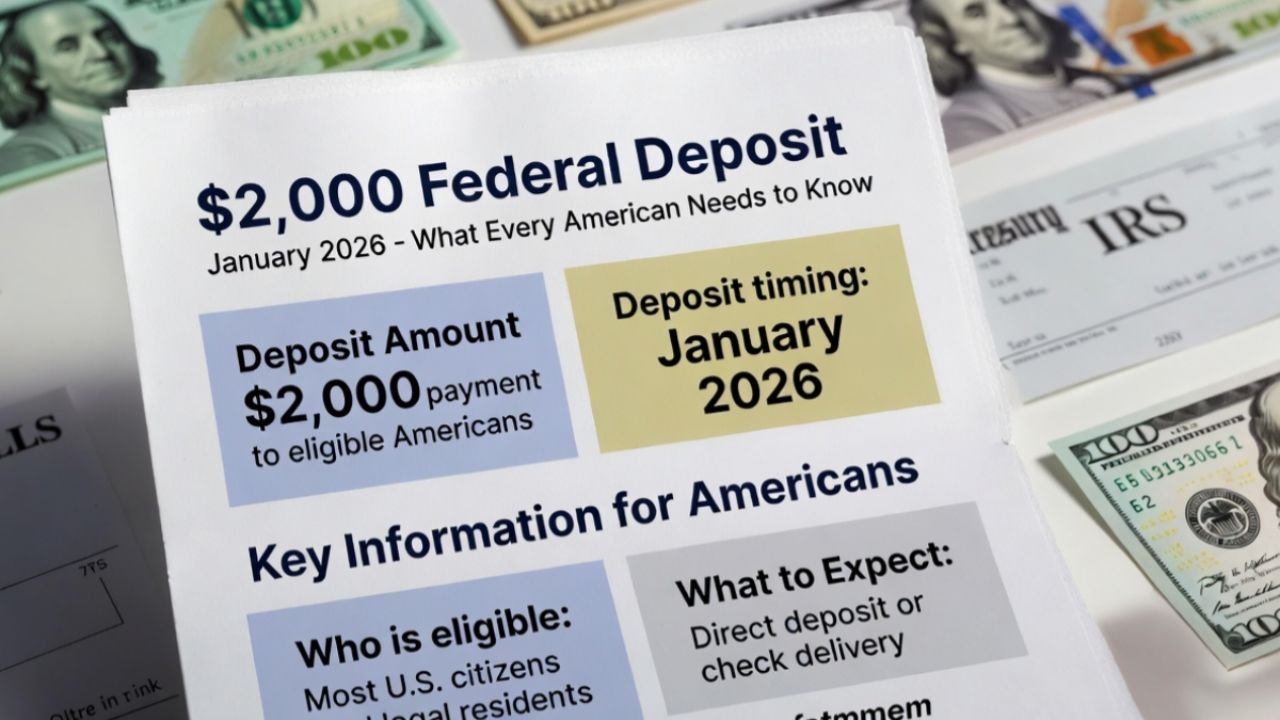
As January 2026 begins, conversations around a possible $2,000 federal deposit are gaining momentum across social media, financial communities, and online news platforms. For many Americans facing persistent inflation, elevated housing costs, and everyday financial pressure, the idea of a substantial federal payment offers a sense of hope. However, while speculation is widespread, clarity is essential. Understanding what this deposit could represent, who might qualify, and how to prepare can help households separate verified information from rumor.
Unlike the emergency stimulus checks issued during the pandemic, any $2,000 federal deposit discussed for January 2026 is not expected to be universal. Instead, it is more closely tied to routine federal benefit adjustments and targeted relief mechanisms already embedded in existing programs.
What the $2,000 Federal Deposit Is Likely to Represent
The potential $2,000 deposit is best understood as a cumulative or one-time adjustment rather than a new nationwide stimulus. Federal programs such as Social Security, Supplemental Security Income, Social Security Disability Insurance, and veterans’ benefits are routinely updated to account for inflation, cost-of-living increases, or administrative corrections.
In some cases, beneficiaries may see larger-than-usual deposits due to retroactive payments, delayed adjustments, or combined benefit increases. When these amounts approach $2,000, they are often mistaken for a new federal relief program. In reality, they are typically tied to existing entitlements rather than a newly approved payment for all Americans.
Who May Be Eligible for a $2,000 Deposit
Eligibility depends entirely on the underlying federal program. Social Security retirees, SSI and SSDI recipients, veterans receiving VA benefits, and low-income households qualifying for refundable tax credits are among the groups most likely to receive payments in this range.
Income thresholds, filing status, and benefit type play a decisive role. Seniors on fixed incomes may benefit from cost-of-living adjustments, while working families could see similar amounts through tax refunds that include refundable credits. There is no single eligibility rule that applies universally, making individual circumstances critical.
Accurate and up-to-date records with federal agencies are essential. Outdated banking details or mailing addresses remain one of the most common reasons for delayed or missed payments.
Expected Timeline for January 2026 Payments
If a qualifying deposit is scheduled, January 2026 is expected to follow standard federal distribution patterns. Direct deposits are typically processed first, often arriving within days of release. Paper checks, where applicable, follow later and may take several weeks.
Payments linked to Social Security or SSI usually align with established monthly benefit schedules, while tax-related deposits depend on filing and processing timelines. This staggered approach can create confusion, as not all recipients receive funds at the same time. Delays do not necessarily indicate a problem; they often reflect routine administrative sequencing.
The Role of Tax Refunds in the $2,000 Narrative
A significant portion of deposits approaching $2,000 in early 2026 will come from federal tax refunds. Households claiming credits such as the Earned Income Tax Credit or Child Tax Credit often see refunds in this range, especially when filing electronically with direct deposit.
These refunds are labeled as U.S. Treasury payments, which can easily be misinterpreted as new federal relief. Understanding this distinction is key to managing expectations and avoiding unnecessary concern when funds arrive.
How to Prepare and Avoid Delays
Preparation remains the most effective way to ensure timely receipt of any legitimate federal payment. Filing 2025 tax returns accurately and on time helps the IRS maintain current banking information. Social Security and SSI recipients should regularly review their account details to confirm accuracy.
Official government portals are the only reliable sources for updates. IRS.gov and SSA.gov provide verified information about benefits, refunds, and payment schedules. Claims circulating on social media or unofficial websites should be treated with caution.
Financial Impact and Responsible Use
For those who receive a $2,000 deposit through benefits or refunds, the financial impact can be meaningful. Such funds can help cover essential expenses like housing, utilities, healthcare, or outstanding debt. However, experts consistently advise against treating one-time payments as ongoing income.
Using these funds strategically—prioritizing urgent needs or reducing high-interest debt—can maximize their value. Temporary relief is most effective when paired with long-term financial planning and realistic budgeting.
Learning from Past Federal Payments
Previous federal payment cycles demonstrate the importance of understanding phased distribution and eligibility rules. Not everyone receives funds simultaneously, and program-specific requirements often dictate timing. Clear communication from federal agencies usually precedes large-scale payments, offering guidance well before deposits occur.
Comparatively, January 2026 payments, where applicable, are expected to follow similar administrative principles rather than introduce an entirely new framework.
Staying Informed and Protecting Yourself
Periods of heightened public interest often attract scams. Fraudulent messages promising guaranteed $2,000 deposits or early access are common during times of uncertainty. Federal agencies do not charge fees to release payments and do not request sensitive information through unsolicited messages.
Staying informed through official channels, maintaining accurate records, and questioning unverified claims are the best defenses against misinformation and fraud.
The Bottom Line
While a universal $2,000 federal deposit for January 2026 has not been officially confirmed, some Americans will legitimately receive payments in this range through existing federal programs or tax refunds. Understanding eligibility, timelines, and preparation steps helps ensure clarity and financial stability.
Until formal announcements are made, cautious optimism paired with verified information remains the most reliable approach for navigating January 2026 with confidence.
Disclaimer: This article is for informational purposes only and does not constitute financial, tax, or legal advice. No universal $2,000 federal deposit has been officially approved for January 2026. Eligibility, timing, and amounts depend on individual circumstances and federal program rules. Readers should consult official government sources or qualified professionals for guidance specific to their situation.